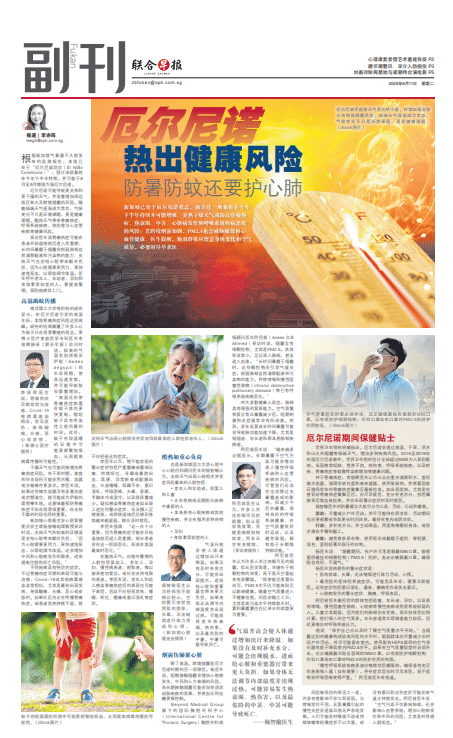
Media Feature | Lianhe Zaobao (联合早报)
Published: 11 August 2026
Journalist: Lee Yi Yun (李亦筠)
With Singapore experiencing El Niño conditions, hotter and drier weather may increase the risk of regional fires and transboundary haze. In a recent Lianhe Zaobao feature, medical specialists discussed how these environmental changes may affect health, from heat related conditions and cardiovascular strain to respiratory problems.
Dr Aneez D.B. Ahmed, Senior Consultant Thoracic Surgeon at International Centre for Thoracic Surgery (ICTS), shared his insights on the potential impact of haze and fine particulate matter on respiratory health.
Haze contains fine particulate matter, particularly PM2.5. Dr Aneez explained that these particles are small enough to penetrate deep into the lungs and may even enter the bloodstream.
With prolonged exposure, fine particles can contribute to airway inflammation, reduce the lungs' natural ability to clear mucus and pollutants, and aggravate existing respiratory conditions such as asthma and chronic obstructive pulmonary disease (COPD).
For most healthy individuals, the lungs have a strong ability to recover. Short term irritation and inflammation may improve when air quality returns to normal and exposure is reduced. However, repeated or prolonged exposure over many years may contribute to a faster decline in lung function, particularly among smokers, older adults and people with existing lung conditions.
One important point highlighted by Dr Aneez is that the potential health impact of haze should not be judged simply by how hazy the sky appears.
From a medical perspective, the concentration of fine particles is more important. PM2.5 levels may still be high enough to affect health even when visibility appears relatively normal. The cumulative amount of exposure can also be more significant than a single day's reading, particularly when elevated pollution levels persist over several days.
Dr Aneez highlighted several groups who may be more vulnerable to the effects of poor air quality, including young children, older adults, pregnant women, people with asthma, COPD or heart disease, and individuals with weakened immune systems.
Children may be particularly vulnerable as their lungs are still developing, while older adults may have lower physiological reserves to cope with additional respiratory stress.
Keeping informed about current air quality levels is an important first step.
When haze reaches levels associated with higher health risks, vulnerable individuals should reduce prolonged outdoor activities where possible. Indoor exposure to PM2.5 may also be reduced with an air purifier fitted with a HEPA filter.
If going outdoors during periods of poorer air quality is necessary, a properly fitted N95 mask can provide protection against fine particles. Surgical and cloth masks provide more limited protection against PM2.5.
People with chronic respiratory conditions should continue taking their medications as prescribed, ensure that rescue inhalers are available where required, and seek medical attention early if symptoms worsen rather than waiting until breathing difficulties become severe.
Fine particles can reach deep into the lungs. PM2.5 exposure can contribute to airway inflammation and affect respiratory health.
Do not judge haze by visibility alone. Fine particle concentration is an important consideration even when the sky does not appear particularly hazy.
Repeated exposure matters. The effects of air pollution may develop gradually, particularly with prolonged or repeated exposure.
Some individuals are more vulnerable. Children, older adults, pregnant women and people with existing respiratory or cardiovascular conditions should take additional precautions when air quality is poor.
Pay attention to persistent symptoms. Throat discomfort or a persistent cough may sometimes be overlooked, but repeated exposure related inflammation can develop gradually.
“Fine particles in haze can reach deep into the lungs and affect respiratory health.”
Dr Aneez D.B. Ahmed
Senior Consultant Thoracic Surgeon
International Centre for Thoracic Surgery
This article summarises Dr Aneez D.B. Ahmed's medical insights featured in Lianhe Zaobao on 11 August 2026. The original feature was reported by Lee Yi Yun (李亦筠). It is intended for general educational purposes and does not replace an individual medical consultation.




Member of Beyond Medical Group
Copyright © 2026 International Centre For Thoracic Surgery. All rights reserved | Terms & Conditions.


